 Whalesmarket
Whalesmarket resell position - Buyer Exits and Collateral Transfer
Whalesmarket resell position lets a buyer exit a filled pre-market order by selling the position to another buyer. The replacement buyer pays the resale price to the exiting buyer and inherits the original buyer’s locked collateral. This creates an exit before the Token Generation Event (TGE), when the token launches. The exit requires a completed resale, and its proceeds depend on the agreed price and applicable fees.
A filled position carries a future delivery agreement. Its resale price, original collateral, and eventual token delivery represent different parts of that agreement.
A resale premium changes the replacement buyer’s entry cost while the original collateral continues to secure the underlying order.
Closing an unfilled offer or reselling a filled position
An unfilled buy offer allows its creator to recover the remaining deposit, less the closing fee, by closing it; a filled position needs another buyer for a resale exit.
Unfilled deposits
Closing an open buy offer stops further fills and returns the uncommitted deposit, less the documented 0.5% closing fee on that amount. A partly filled offer therefore contains distinct balances: an unfilled remainder and deposits committed to completed matches. Closing the offer does not release the funds backing those filled orders. Treating the entire offer as one refundable balance would overstate the amount available to withdraw.
Filled commitments
A filled buyer position remains tied to a seller’s future delivery obligation. Resale supplies a secondary exit for that position before TGE. The original seller continues to owe the tokens under the underlying agreement. The exiting buyer needs someone to purchase that existing position, even when the original match has already committed both parties’ collateral.
The position, the payment, and the collateral
A resale changes the buyer holding the delivery rights while leaving the original token seller responsible for settlement. The payment for that transfer has a separate destination from the collateral.
The original token seller
The original token seller commits collateral against the agreed allocation. Successful delivery releases the original purchase payment and returns the seller’s collateral, subject to applicable charges. A secondary buyer’s higher entry price does not rewrite the original trade value or provide the seller with that resale premium.
The exiting buyer
The exiting buyer receives payment from the replacement buyer when the resale executes. Their original deposit remains locked as security associated with the transferred position. Receiving that payment does not require the contract to unlock the underlying deposit before settlement.
The replacement buyer
The replacement buyer takes over the position and the collateral that backed the original buyer’s commitment. They pay for rights under an existing trade. The resale transaction does not deliver the future tokens immediately, and the original collateral can differ from their secondary purchase price.
Does creating a resale listing complete the exit?
Creating a resale listing leaves the exit incomplete until another buyer accepts its terms and the transfer executes. A listing can remain unmatched even when its price falls within the permitted range.
Resale prices and the original collateral value
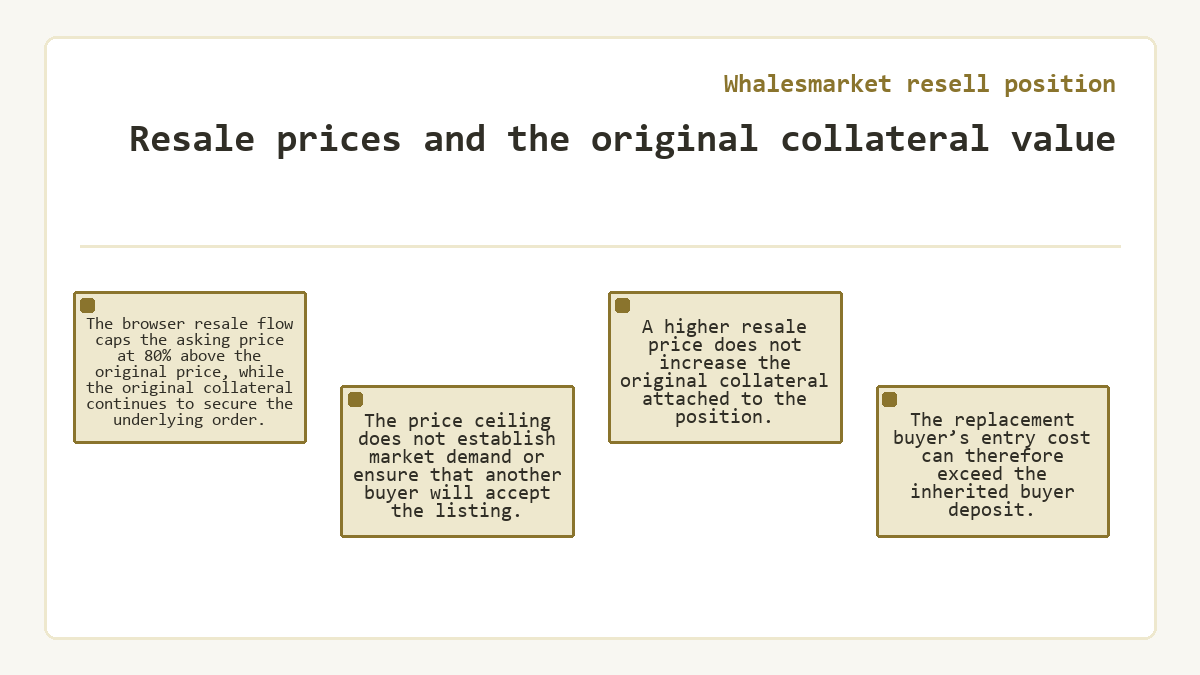
The browser resale flow caps the asking price at 80% above the original price, while the original collateral continues to secure the underlying order. The price ceiling does not establish market demand or ensure that another buyer will accept the listing.
A higher resale price does not increase the original collateral attached to the position. The replacement buyer’s entry cost can therefore exceed the inherited buyer deposit.
Resale proceeds and settlement charges
Resale charges affect the amount received on the secondary transaction, while settlement charges concern the final buyer and original seller. The resale fee applies when the resale successfully executes. Final settlement fees use the underlying trade’s notional value, meaning its agreed quantity multiplied by its original price.
The browser confirmation displays the resale price, fees, and expected receipt. Those fields distinguish the gross sale value from the proceeds that the exiting buyer expects to receive. An increase over the original purchase price alone does not establish net profit. Profit also depends on the original position cost and the charges incurred in acquiring and exiting it.
The expected receipt is a quote until execution completes.
Premium-based risk labels
The browser risk labels classify the previous buyer’s price uplift, with thresholds below 50%, from 50% to below 75%, and at least 75%. These correspond to low, medium, and high risk in that interface. The medium band displays a warning; the high band requires confirmation of the warning before purchase.
The percentage compares the resale entry price with the original price. It does not measure the replacement buyer’s future return or the probability of token delivery. The low band has no warning message under this classification. Other settlement conditions still apply to that position, including the original seller’s obligation and the market’s cancellation terms.
Listing a filled position and confirming the resale
A buyer seeking an early resale exit needs a filled buy position before committing to a secondary listing. An open offer with no completed match lacks that prerequisite. The order status determines which action can release funds or transfer the position.
- Find your filled buy order in the Dashboard or the token’s Trading Terminal, review its original terms, and select Resell. If the offer remains entirely unfilled, closing that offer returns its unfilled deposit, less the closing fee.
- Enter the quantity to resell and set the asking price. The browser price ceiling limits the premium over the original entry price.
- Read the confirmation’s fees and expected receipt before authorizing the listing transaction. Publishing the offer still leaves the position awaiting a replacement buyer.
- Look for a completed resale fill and the resulting payment. A wallet signature or an open listing alone does not establish that the exit produced proceeds.
- Review the resale status alongside the underlying order details. The completed transfer determines who holds the position for later settlement.
Unfilled resale offers and cancellation
Canceling an unfilled resale offer withdraws the secondary listing and reclaims the order position for its creator.
The command-line interface provides this operation through its resale-offer cancellation command. Canceling that listing does not cancel the original filled trade or turn its committed collateral into a refundable open-offer deposit.
A resale offer can also carry an expiry. That expiry belongs to the secondary listing, while the underlying order retains its settlement conditions. An asking price and a future listing deadline do not establish that the position will remain eligible for purchase throughout that interval.
Token delivery and seller default after a resale
The replacement buyer becomes the recipient of token delivery or an eligible default claim under the original order. The original token seller must deliver to the buyer who holds the position at settlement. Changing the buyer does not remove the seller’s delivery obligation or reset the original trade’s collateral value.
If the seller misses the applicable settlement deadline, the current buyer gains the right to cancel for compensation. Until cancellation, the seller can still settle an overdue order. An eligible default claim returns the inherited buyer collateral and the original seller’s collateral, subject to fees. That compensation supplies funds rather than the promised tokens, and its basis remains the original trade.
Market cancellation and the resale premium
Market cancellation can leave a replacement buyer with less than their resale purchase cost because the refund uses the inherited buyer collateral. Cancellation differs from an original seller failing to deliver within an active settlement process. The distinction changes which collateral the current buyer can receive.
Trading may be canceled when the project does not establish token liquidity on the listing blockchain. On pre-market cancellation, a resale buyer receives the original buyer’s collateral. The payment made to the exiting buyer has already left the escrow arrangement. A purchase premium can therefore become a loss, even though the buyer inherits collateral and the resale respects the price ceiling.
Whalesmarket resell position questions worth asking
Can I resell a position filled from my own buy offer?
A filled buyer position can enter the buy-side resale flow even when it originated from your own buy offer. Creating the offer alone does not establish that position. A seller must have filled the relevant quantity, and the position must remain eligible for resale.
Where does the trading terminal identify resale orders?
The browser trading terminal identifies resale offers with an RS tag. That tag distinguishes a secondary position listing from an original token seller’s offer. The purchase transfers an existing buyer position, so its quoted entry price can differ from the original trade price.
What can I do if my filled order is missing from the resale panel?
Reloading the trading terminal can restore an order that is missing from its display. The Dashboard also provides access to filled buy orders and their details. A missing row alone does not establish that the order has disappeared from the contract or become eligible for cancellation.
Does the CLI support position resale on every supported network?
The command-line interface documents its position-resale commands for EVM networks and Solana. Its broader support for pre-market trading does not establish resale support on every network. The specific resale command and the chain holding the underlying order determine the applicable interface support.
How does the CLI express a resale asking price?
The CLI expresses the resale price per allocated token in units of the selected exchange token. Its resale-creation command accepts an exchange-token address, and omission selects the chain’s native payment asset. The price therefore needs its payment unit to be meaningful; it is not automatically a dollar quote.
What format does the CLI use for a resale-offer deadline?
The CLI uses a Unix timestamp for an explicit resale-offer deadline. That value specifies when the secondary listing expires. It does not set the token launch date or alter the underlying order’s settlement conditions, so a future expiry alone does not establish continued resale eligibility.
Last updated: