 Whalesmarket
Whalesmarket settlement delivers tokens when sellers fulfill their pre-market orders
Whalesmarket settlement completes a filled pre-market order when the seller delivers the agreed tokens and the contract releases payment. Buyer funds remain in escrow pending delivery or an eligible refund. If the seller misses the applicable deadline, the buyer can cancel for collateral compensation, which does not supply the promised tokens.
Filled quantities and committed collateral
The filled quantity determines how many tokens the seller owes, while the agreed price establishes the trade value. Both parties lock funds equal to that value. In the standard pre-market escrow flow, the buyer’s deposit finances the purchase; the seller’s collateral secures the delivery commitment. Those balances serve different purposes despite matching in value.
An open offer and a filled order represent different commitments. Creating an offer records terms that another participant can accept. A fill commits the corresponding quantity to a delivery agreement. The amount still advertised in an offer therefore does not establish how many tokens a particular buyer will receive at settlement.
Token delivery and the release of payment
Tokens available for delivery
The seller needs access to transferable tokens before the settlement process can fulfill the delivery obligation. A future allocation or an expected project distribution does not put transferable tokens into the settlement wallet. A claim, unlock, or supported delivery route may be necessary before the seller can supply the asset.
The Dashboard allows sellers to select the orders that they intend to settle. Its confirmation shows the total token requirement. Approving the settlement request authorizes the connected wallet’s on-chain action. The selected quantity must correspond to the actual orders, including any separate fills.
Payment and returned seller collateral
Successful settlement releases the buyer’s payment and returns the seller’s collateral, subject to applicable platform fees. The buyer receives the settlement tokens. The Platform Fees guide lists a 2.5% purchase fee based on tokens purchased, deducted after successful settlement. The Fees Structure guide for Resell Position instead describes settlement charges of 2.5% of trade value from each party’s collateral. The documentation does not establish which fee basis applies to a particular order. Default-cancellation fees apply to deposits and collateral.
When does the settlement countdown start?
The normal four-hour settlement countdown begins when the token is officially listed on markets and settlement activates. Placing or filling an order does not start this countdown.
Normal settlement assumes that tokens are claimable and that any required delivery route works. Filled commitments remain locked before the Token Generation Event (TGE), when ordinary settlement and default cancellation are unavailable.
The Dashboard separates upcoming settlement schedules from current settlements, giving each token’s delivery period its own context. An activated outage extension can change the deadline that governs a filled order.
Can an overdue seller still deliver tokens?
An overdue seller can still deliver while the order remains unsettled and the buyer has not canceled. Expiry grants the buyer a cancellation right. Waiting leaves delivery possible; an eligible cancellation resolves the order through its collateral claim.
Default compensation and its limits
Seller default can leave the buyer without tokens even when the trading infrastructure works correctly. A rising launch price may make forfeiting collateral economically preferable for the seller. The contract enforces the collateral consequence; it does not compel the seller to supply the token or replace the missed allocation.
Returned deposit and compensation
The buyer’s default claim combines the original buyer’s deposit with the seller’s forfeited collateral. In a direct purchase, returning the buyer’s own money is separate from the compensation that the seller funds. The standard pre-market default-cancellation schedule deducts 2.5% from the buyer’s deposit and 2.5% from the seller’s collateral. Those deductions reduce the amount that the buyer actually receives.
Collateral reflects the agreed trade value, not the token’s later market value. A default payout therefore does not promise enough money to replace the allocation at its launch price. The relevant comparison is the recoverable balance against the cost of the missing tokens, with fees included.
An overdue claim with equal collateral
Can collateral recovery fulfill the same purpose as token delivery? In a hypothetical direct purchase, the buyer deposits 173 units of the order’s payment asset. The seller locks an equal 173 units against delivery. If the seller fails to deliver and the buyer completes an eligible overdue cancellation, the gross claim combines both balances: 173 + 173 = 346 units before applicable fees.
The 346 units consist of the buyer’s returned principal and the seller-funded compensation. The buyer receives no purchased tokens through that cancellation. This calculation applies to seller default on the direct purchase. Cancellation of the entire market follows a different refund rule.
Delivery across different chains
Cross-chain settlement permits orders on a different blockchain from the token’s original supply. Order creation and settlement use the listing chain; originals exist on the TGE chain. The Buyer Settlement Flow guide treats collateral as a participation guarantee and requires buyers to hold the payment token on the listing chain. In that flow, the buyer signs a separate payment transaction there, then manually initiates a bridge to receive native tokens on the TGE chain. Native delivery requires that bridge to complete.
Original tokens and wrapped delivery tokens
The cross-chain mechanism locks original tokens on the TGE chain and supplies equivalent wrapped tokens on the listing chain. Confirmed bridging prevents reuse or withdrawal of those originals before settlement completes.
Each wrapped token in this settlement model has 1:1 backing from locked original tokens. The ratio describes token quantities, without fixing a market price.
Cross-chain message confirmation
LayerZero confirms messages between networks. Bridge-dependent settlement requires that confirmation, so signing a transfer alone does not establish delivery.
Sufficient tokens already on the listing chain
The seller’s bridge step is required only if the available wrapped-token balance cannot fulfill the order. An adequate listing-chain balance allows that step to be skipped.
Claim outages and unavailable bridge routes
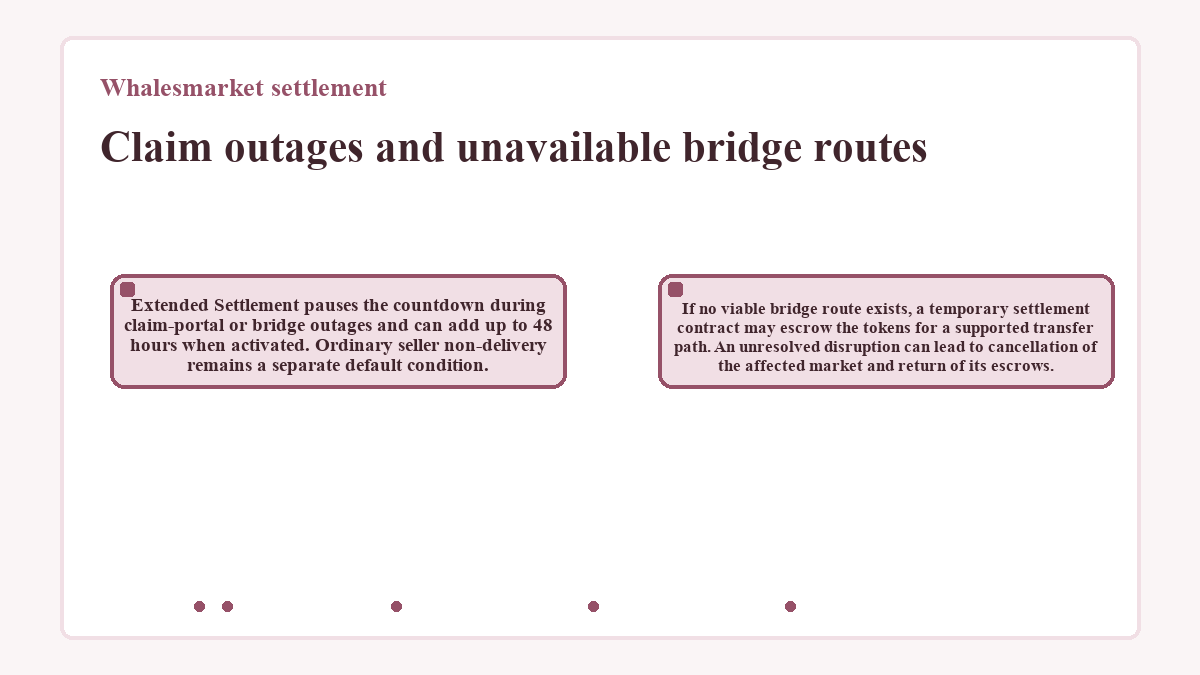
Extended Settlement pauses the countdown during claim-portal or bridge outages and can add up to 48 hours when activated. Ordinary seller non-delivery remains a separate default condition.
If no viable bridge route exists, a temporary settlement contract may escrow the tokens for a supported transfer path. An unresolved disruption can lead to cancellation of the affected market and return of its escrows.
Market cancellation and seller default
Cancellation of an entire pre-market returns the buyer-side deposit to the current buyer and the seller’s collateral to the seller. The seller receives no pre-market sale proceeds. An individual seller default instead exposes that seller’s collateral to the buyer’s overdue claim.
Settlement rights after a position resale
A completed position resale changes the buyer who holds the delivery right while retaining the original seller’s obligation. The current holder inherits the original buyer’s locked collateral. Successful settlement delivers the tokens to that holder. Seller default makes the original buyer’s deposit and original seller’s collateral available under the default rules.
The resale payment goes to the exiting buyer, so it does not automatically enlarge the inherited escrow. If the platform cancels the market, the resale buyer receives the inherited original buyer collateral. The resale price can therefore exceed the refundable balance.
Popular questions about Whalesmarket settlement
What wallet must a seller use to settle an order?
The seller settlement workflow requires the wallet that originally created or filled the order. That wallet also needs the tokens required for delivery. Connecting another wallet does not establish that it controls the existing seller obligation. The settlement confirmation should correspond to the orders associated with the original wallet.
Does closing an open offer also release collateral committed to filled orders?
Closing an open offer releases only the remaining unfilled deposit or collateral, subject to the applicable closing fee. It stops additional fills without undoing existing delivery commitments. The funds assigned to filled orders remain governed by settlement, eligible overdue cancellation, or cancellation of the market. This distinction applies to both buy and sell offer creators.
Can I identify a settlement order by its UUID in the CLI?
The command-line interface (CLI) accepts an order’s universally unique identifier (UUID) for whales trade settle and resolves settlement details through the application programming interface (API). These include the chain, on-chain order identifier, settlement token address, and amount. For an Ethereum Virtual Machine (EVM) order, using its on-chain identifier instead requires explicit chain, token-address, and amount arguments. Executing settlement still requires the seller’s configured signing wallet.
Why can fills of the same partial offer have different settlement outcomes?
A partial offer can produce filled orders involving different counterparties, each with its own delivery commitment. One seller’s fulfilled quantity does not prove that another seller has supplied theirs. The token’s settlement schedule governs the relevant orders, while delivery and eligible default claims concern their individual obligations. Treat an offer’s aggregate quantity separately from the state of each fill.
How does the EVM settlement command interpret the token amount?
An Ethereum Virtual Machine (EVM) settlement command takes the amount in human-readable token units. Token decimals determine the conversion between that amount and the integer quantity used on-chain. The CLI detects decimals from the token contract when no override is supplied. A decimal override must match the token’s actual precision to preserve the intended delivery quantity.
Is a wallet approval enough to confirm that an order has settled?
A wallet approval authorizes an action. Completion requires a successful settlement transaction confirmed on-chain. The order moves to Settled after confirmation, when token delivery and the corresponding release of funds take effect. A pending transaction or its identifier alone does not establish that final state. Bridge-dependent settlement also requires its cross-chain message confirmation. In the documented buyer-side cross-chain flow, native tokens arrive only after the buyer’s manually initiated bridge to the TGE chain completes.
Last updated: